
A color analysis app for your season and palette
In short
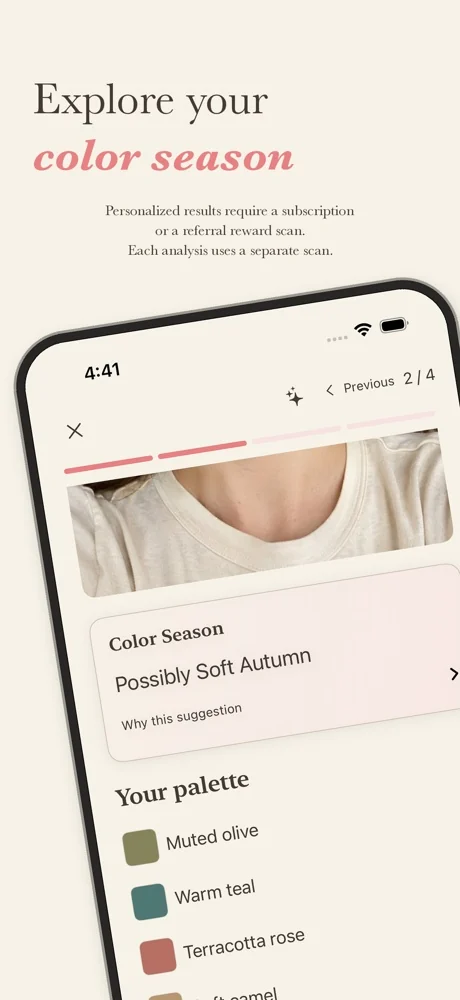
Color Analysis is one of three scans in GlowUp Girlie, an iPhone app coming soon to the App Store. From a selfie it suggests an indicative color season (for example "possibly Soft Autumn"), your undertone and a palette to try, and explains why for each. Lighting and camera change how color shows up, so treat it as a strong starting point, not a verdict. It's a separate scan from Facial Analysis and the Glow Up Guide, and needs a weekly plan or a referral reward scan. The free color season quiz on this site works today.
Key takeaways
- You get three things: an indicative season, your undertone and a palette to try, each with a "why this suggestion".
- Soft daylight, no filter and little or no makeup give the most reliable read.
- Your result is saved, so you can reopen your palette any time without another scan.
- The free color season quiz and undertone test on this site work today, with no photo at all.
On this page6 sections
What does the Color Analysis scan show?
It suggests colors to try from one selfie. The app isn't out yet, but the free color season quiz gives you a head start today, with no photo and no account.
| You get | What it means |
|---|---|
| An indicative season | A seasonal color type, worded honestly: for example "possibly Soft Autumn" |
| Your undertone | Whether your skin leans cool, warm or neutral, or "uncertain" when the photo can't tell |
| A palette to try | Named colors, like muted olive, warm teal, terracotta rose, soft camel and dusty peach |
| Why this suggestion | A short explanation behind each result, so you can judge it yourself |
The result is saved in the app. You can reopen it while shopping or getting dressed without scanning again.
Want to read about each season first? The color analysis guide covers all 12, with approximate swatches.
How does it suggest a season from a selfie?
A season sums up three things about your natural coloring:
- Temperature: does your coloring lean warm (golden, peachy) or cool (pink, blue-red)?
- Depth: are your skin, hair and eyes light, medium or deep overall?
- Chroma: does your coloring look soft and muted, or clear and bright?
The scan looks at how your coloring reads in your photo and suggests the season that fits best, with your undertone and a palette that follows from it. Curious which one you are? Read what season am I, or check your base with the undertone test.
How accurate is color analysis from a photo?
Photo color analysis is a strong guide, not a lab test. Here is the honest version.
Cameras adjust colors to the light they see. A warm lamp pushes skin toward orange. Shade and screens push it toward blue. Filters and portrait modes change it again. That's why the result says "possibly", and why one thing matters most: a selfie facing a window, in daylight, with no filter.
Some limits no app can remove:
- Makeup and self-tan change how your skin reads. A bare or nearly bare face works best.
- Dyed hair can pull a result. Your natural hair color tells more about your season.
- In-between coloring is real. Many people sit close to two seasons.
- Color analysis isn't an exact science. Different systems sort colors in slightly different ways.
An in-person session, where a trained analyst holds fabric drapes under your chin in good light, can go further than any photo. If you're torn between two seasons, try both palettes against your face in daylight and trust what your eyes see.
Free toolUndertone testCool, warm, neutral or olive, from simple at-home checks.Does it work for every skin tone?
Yes. Every season includes deep, medium and fair skin. Fair skin can be a Deep Winter when hair and eyes are very dark, and deep skin can sit in any of the four season families, depending on warmth and clarity. The season is about the whole picture, not skin depth alone. GlowUp Girlie never suggests lightening your skin.
What does it cost?
Color Analysis uses one successful scan. Scans come with a weekly plan ($6.99 a week for 1 scan in the US, up to $12.99 for 4, no free trial), or you can earn one free scan by inviting three new devices. A failed scan doesn't use your allowance. Full details are on how it works.
Comparing apps? Our best color analysis apps guide lists real options with their App Store details.
What can I do with my palette?
Open the scan assistant and describe an outfit, like a navy dress, to get palette-based ideas for shoes and accessories. For makeup steps that suit your features, the Facial Analysis scan is the next stop.
Questions people ask
How does a color analysis app work?
A color analysis app looks at your coloring in a photo: how warm or cool your skin looks, how light or deep your skin, hair and eyes are, and how soft or clear your coloring is overall. It matches that to a seasonal color type. GlowUp Girlie's Color Analysis scan suggests a season, your undertone and a palette to try, and explains each suggestion.
Is photo color analysis accurate?
It can be a strong guide, but it depends on the photo. Warm lamps, shade, screens, filters and makeup all change how color shows up on camera, which is why GlowUp Girlie calls its season indicative ("possibly Soft Autumn") rather than certain. Take your selfie facing a window in daylight with no filter, and compare the palette against your face in daylight.
How much does the Color Analysis scan cost?
It uses one successful scan from a weekly plan: $6.99 a week for 1 scan, $9.99 for 2 or $12.99 for 4 in the US, with no free trial. You can also earn one free scan, once, when three new devices set up GlowUp Girlie with your invite. Saved results reopen free.
Do I get my face shape from the same scan?
No. Color Analysis, Facial Analysis and the Glow Up Guide are separate scans. Color Analysis covers your season, undertone and palette. Face and eye shape come from the Facial Analysis scan.
Does it work on deep skin?
Yes. Seasons describe the whole picture of skin, hair and eyes, not skin depth alone, so deep, medium and fair skin appear in every season family. GlowUp Girlie never suggests lightening your skin.
Sources
- Color analysisWikipedia, 2026
- Color balanceWikipedia, 2026